publications
2025
-
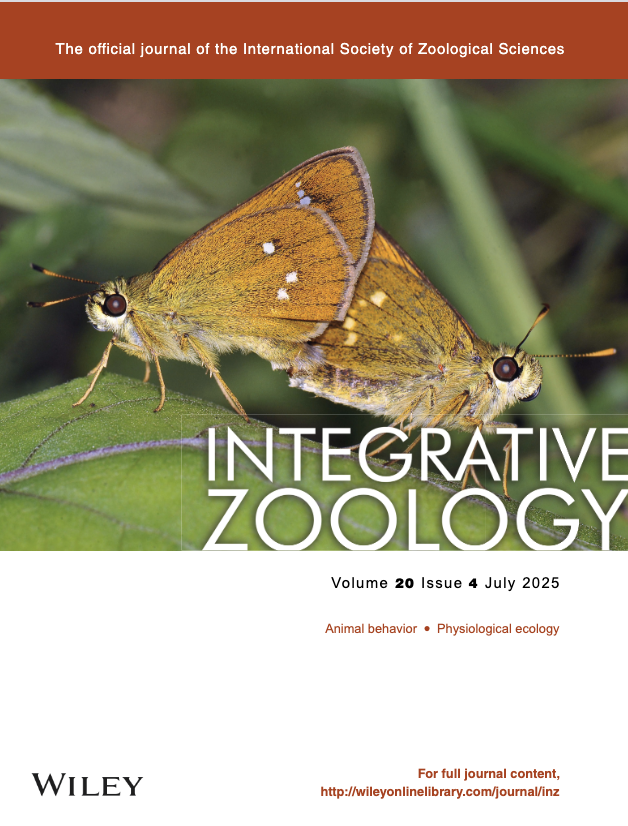 Allometric Constraint Predominates Over the Acoustic Adaptation Hypothesis in a Radiation of Neotropical TreefrogsM Escalona, PI Simões, A Gonzalez-Voyer, AM Mendoza-Henao, A Mello Bezerra, PDP Pinheiro, B Morales, JM Guayasamin, T Carvalho, JC Chaparro, I Riva, FJM Rojas-Runjaic, M Rivera-Correa, PJR Kok, P Peloso, DYM Nakamura, R Maneyro, and S Castroviejo-FisherIntegrative Zoology 2025
Male frogs emit stereotypical advertisement calls to attract mates and deter conspecific rivals. The evolution of these calls is thought to be linked to anatomical constraints and the acoustic characteristics of their surroundings. The acoustic adaptation hypothesis (AAH) posits that species evolve calls that maximize propagation distance and reduce signal degradation in the environment where they are emitted. We applied phylogenetic comparative analyses to study the association of body size, vegetation density, type of aquatic ecosystem, and calling site on the evolution of acoustic traits in Cophomantini, a large radiation of Neotropical treefrogs (Hylidae). We obtained and analyzed body size, acoustic, and habitat data from a total of 112 species (58% of Cophomantini), using the most inclusive available phylogeny. We found a significant negative correlation between peak frequency, body size, and calling site, but contrary to the predictions of the AAH, we did not find support for associations among call traits and environmental characteristics. Although spectral allometry is explained by an anatomical constraint, it could also be maintained by female choice. We recommend that future studies strive to incorporate factors such as female mate preferences, eavesdropping by predators or parasites, and genetic drift.
-
 Phylogenetics, biogeography, and life history evolution in the broadly distributed treefrog genus Dendropsophus (Anura: Hylidae: Hylinae)C Whitcher, VGD Orrico, S Ron, ML Lyra, CS Cassini, RB Ferreira, DYM Nakamura, PLV Peloso, MA Rada, M Rivera-Correa, MJ Sturaro, PH Valdujo, CFB Haddad, T Grant, J Faivovich, A Lemmon, and EM LemmonMolecular Phylogenetics and Evolution 2025
Dendropsophus is one of the most species-rich genera of hylid treefrogs. Recent studies integrating Sanger-generated mitochondrial and nuclear loci with phenomic characters (SP) have advanced understanding of this clade, but questions about its internal relationships and biogeographic history persist. To address these questions, we used anchored hybrid enrichment (AHE) to combine 432 nuclear loci for 78 taxa (72 % of species) with published data. Quantitatively, the impact of the AHE data was modest, with compositional differences in only three recognized clades and more than 80 % of the clades in the AHE + SP analyses also supported in the SP-only analyses. Nevertheless, the impact of AHE was crucial for resolving and increasing support for multiple nodes. We transferred one species of the former D. ruschii group to the D. decipiens group and redefined the D. leucophyllatus group to avoid paraphyly. We estimated divergence times to reconstruct the clade’s biogeographic history. We also examined evolution of oviposition sites and assessed its effect on lineage accumulation. Dendropsophus likely originated ∼ 57 mya, predating the Andean uplift, with some taxa showing dispersal patterns less constrained by ecological changes than previously thought.
-
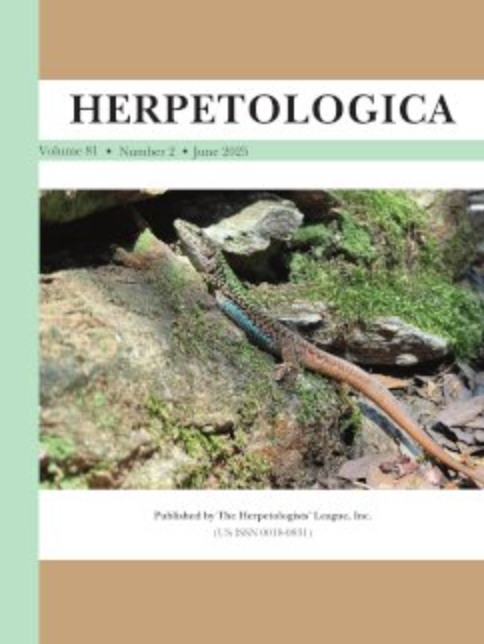 Historical DNA places an apparently extinct gladiator frog in the phylogeny of the Boana pulchella group (Anura: Hylidae)DYM Nakamura, PDP Pinheiro, ML Lyra, J Faivovich, and T GrantHerpetologica 2025
Boana cymbalum has not been collected for the past six decades and is one of the two species of Brazilian frogs formally considered to be extinct. It is also the only species of the B. pulchella group that has never been included in molecular phylogenetic analyses, because no fresh tissue is available. Using specialized historical DNA (hDNA) extraction protocols and high-throughput sequencing, we obtained mitochondrial and nuclear sequences from the 62-yr-old holotype of B. cymbalum. Our results place B. cymbalum as the sister taxon of the clade formed by B. prasina, B. cordobae, and B. pulchella, supporting its inclusion in the B. prasina clade. The scars on the dorsum of adult males suggest male–male combat. Microcomputed tomography revealed the presence of a large postarticular process and a distal prepollex directed laterad to pass ventral to Metacarpal II, two known synapomorphies of the B. pulchella group. On the basis of recordings from 1963, we provide an expanded description of the vocalization of B. cymbalum, consisting of a short, tonal note (Note A) and a longer, multipulsed note (Note B). Finally, we discuss the conservation status of B. cymbalum and the potential application of the newly generated hDNA sequences to screen water bodies near the type locality using environmental DNA in an effort to rediscover this species.
-
 Body size, habitat, and sexual selection affect call evolution in Cophomantini treefrogs (Anura: Hylidae: Hylinae)DYM Nakamura, M Escalona, and PDP PinheiroBiological Journal of the Linnean Society 2025
Advertisement calls are emitted by anuran males to attract females or repel competitors. Call frequencies are coupled with the vocal apparatus and, thus, likely with body size due to allometric constraints. Physical properties of the habitat might affect the evolution of advertisement calls through natural selection, with high- and low-frequency calls expected in lotic and lentic environments, respectively. Conversely, call frequencies may be influenced by sexual selection because low-frequency sounds are predicted to be perceived as more intimidating in intrasexual competition and more attractive in female choice. In addition, although the evolution of dominant frequencies has been investigated in anurans, little is known about fundamental frequencies. Here we investigated whether body size, habitat, and sexual selection are associated with the evolution of dominant and fundamental frequencies of the vocalizations in the Neotropical hylid tribe Cophomantini, using phylogenetic comparative methods. We found that body size and habitat predict dominant frequency across the phylogeny, whereas only body size is correlated with fundamental frequency. Reproduction in lotic environments is plesiomorphic for the tribe, with changes to lentic environments concentrated in some Boana clades. Intensity of sexual selection is negatively correlated with dominant frequency in Bokermannohyla, in which low-frequency calls are expected under strong sexual selection. Our results illustrate how the interplay between body size, habitat, and sexual selection may affect the evolution of spectral traits.
-
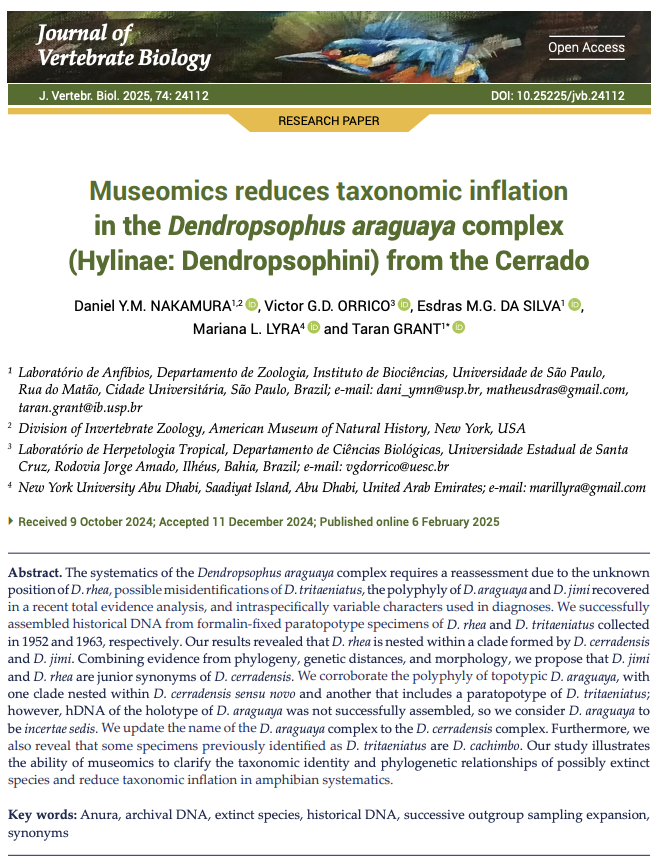 Museomics reduces taxonomic inflation in the Dendropsophus araguaya complex (Hylinae: Dendropsophini) from the CerradoDYM Nakamura, VGD Orrico, EMG Da Silva, ML Lyra, and T GrantJournal of Vertebrate Biology 2025
The systematics of the Dendropsophus araguaya complex requires a reassessment due to the unknown position of D. rhea, possible misidentifications of D. tritaeniatus, the polyphyly of D. araguaya and D. jimi recovered in a recent total evidence analysis, and intraspecifically variable characters used in diagnoses. We successfully assembled historical DNA from formalin-fixed paratopotype specimens of D. rhea and D. tritaeniatus collected in 1952 and 1963, respectively. Our results revealed that D. rhea is nested within a clade formed by D. cerradensis and D. jimi. Combining evidence from phylogeny, genetic distances, and morphology, we propose that D. jimi and D. rhea are junior synonyms of D. cerradensis. We corroborate the polyphyly of topotypic D. araguaya, with one clade nested within D. cerradensis sensu novo and another that includes a paratopotype of D. tritaeniatus; however, hDNA of the holotype of D. araguaya was not successfully assembled, so we consider D. araguaya to be incertae sedis. We update the name of the D. araguaya complex to the D. cerradensis complex. Furthermore, we also reveal that some specimens previously identified as D. tritaeniatus are D. cachimbo. Our study illustrates the ability of museomics to clarify the taxonomic identity and phylogenetic relationships of possibly extinct species and reduce taxonomic inflation in amphibian systematics.
2024
-
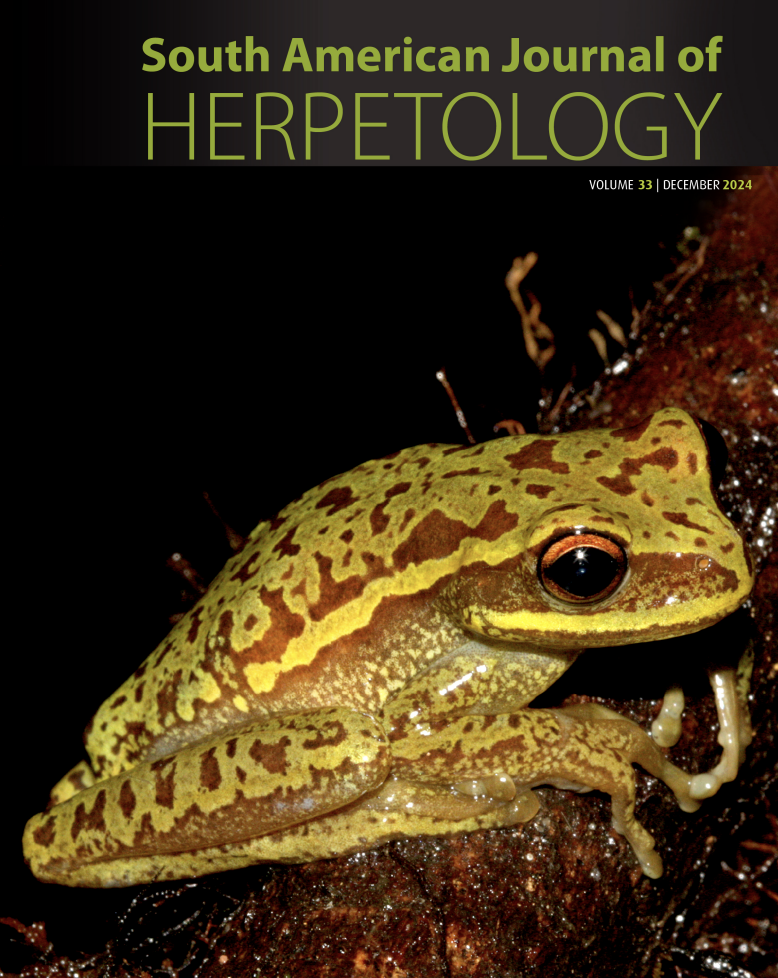 Two new species of the Boana semiguttata clade (Anura: Hylidae: Hylinae) from the Atlantic Forest of Southern BrazilPDP Pinheiro, F Dallacorte, J Thompson, EJ Comitti, DYM Nakamura, and PCA GarciaSouth American Journal of Herpetology 2024
We describe two new species of the Boana pulchella group, nested within the B. semiguttata clade and previously referred to as Boana sp. 1 and Boana sp. 2. Both species inhabit the Atlantic Forest of Santa Catarina state, southern Brazil. Boana sp. 1 is known from Parque Nacional da Serra do Itajaí. It resembles B. joaquini and B. stellae in external morphology but is distinguishable by its snout–vent length, coloration pattern, and advertisement call. Although its call structure differs from all other B. semiguttata clade species, it is strikingly similar to that of B. marginata, a distantly related species of the B. pulchella group. Boana sp. 2 is known only from a single locality in Serra do Quiriri (municipality of Garuva). Morphologically and acoustically, it is highly similar to B. semiguttata, differing only in color pattern and DNA sequences. Like all other species of the B. semiguttata clade, both new species breed in in montane streams and exhibit hypertrophied forearms in adult males. While Boana sp. 1 occurs in a protected area within a national park, the only known locality of Boana sp. 2 is under threat of habitat loss and other anthropogenic pressures.
-
 Defensive alkaloid variation and palatability in sympatric poison frogsJ Albuquerque-Pinna, AM Jeckel, DYM Nakamura, PS Bernarde, S Kocheff, RA Saporito, and T GrantChemoecology 2024
Chemical defense in poison frogs derives from lipophilic alkaloids sequestered from dietary arthropods. Alkaloid composition varies extensively among individuals, populations, and species. Numerous causes of intraspecific variation have been identified, but the causes of interspecific variation are less clear, with both intrinsic (e.g., mechanism of sequestration) and extrinsic (e.g., arthropod availability) explanations being possible. Sympatric species afford a unique opportunity to investigate the causes and consequences of interspecific variation in natural populations, since they are potentially exposed to the same arthropod prey and predators. We used gas chromatography–mass spectrometry to identify alkaloids from 36 individuals of six species and three genera of dendrobatid poison frogs (Adelphobates, Ameerega, and Ranitomeya) collected in three Amazonian localities. We then compared alkaloid composition, richness, and quantity among sympatric species and analyzed the variation in alkaloid composition among con- and heterospecific populations at the two nearest localities. We also performed arthropod palatability experiments to investigate the biological significance of differences in alkaloids among sympatric species. Sympatric species differed in alkaloid composition, richness, and quantity, and conspecific individuals from different localities shared more alkaloids than heterospecific individuals from the same locality, strongly suggesting that variation is due to intrinsic causes. All analyzed alkaloid secretions were unpalatable, but palatability scores did not differ for most sympatric species, despite significant differences in alkaloid composition, richness, and quantity. Our results provide insights into the causes and consequences of interspecific variation in alkaloid profiles, but additional data are required to identify specific intrinsic causes and predator responses.
-
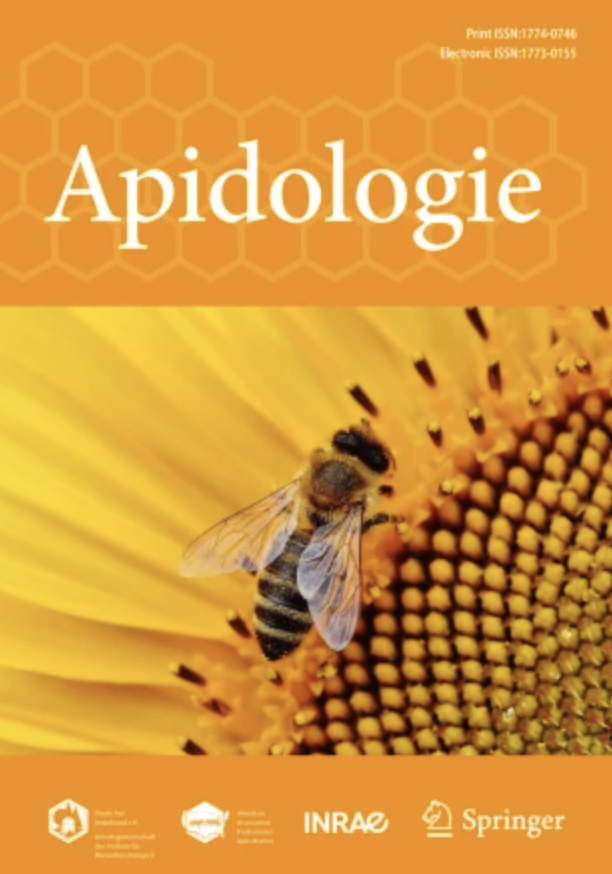 Resin foraging interactions in stingless bees: an ecological synthesis using multilayer networksDYM Nakamura, S Koffler, MAR Mello, and TM FrancoyApidologie 2024
Stingless bees use resins for nest construction, colony defense, and production of cerumen, propolis, and geopropolis. Despite their importance, resin foraging interactions are neglected in stingless bee ecology, so a synthesis is required to map how much we currently know about this topic. In addition, what kind of networks do those interactions form? The Integrative Hypothesis of Specialization (IHS) may provide a cognitive map to generate predictions and interpret results. Specifically, resin heterogeneity, phylogeny, and geography may create interaction constraints that generate a modular or compound topology in resin foraging networks. Here we systematically reviewed resin foraging interactions with a multilayer network approach accounting for biogeographical structure. A total of 1,037 bee–plant resin foraging interactions were retrieved and Anacardiaceae and Dipterocarpaceae were identified as the most frequently visited plant families worldwide. As deduced from the IHS, we found a modular topology in most cases. A compound topology was only found with a less conservative approach considering all data. In most cases, Mantel tests revealed that interactions, modules, and layers are constrained by phylogeny and geography. Our results suggest that closely related species tend to interact with similar plant genera and from the same biogeographical region. Body size was positively correlated with centrality, indicating that larger bees use highly connected plants. We hope our findings highlight the ecological patterns and drivers that shape resin foraging interactions in stingless bees. Moreover, we discuss methodological recommendations and knowledge gaps, helping to guide future studies.
2021
-
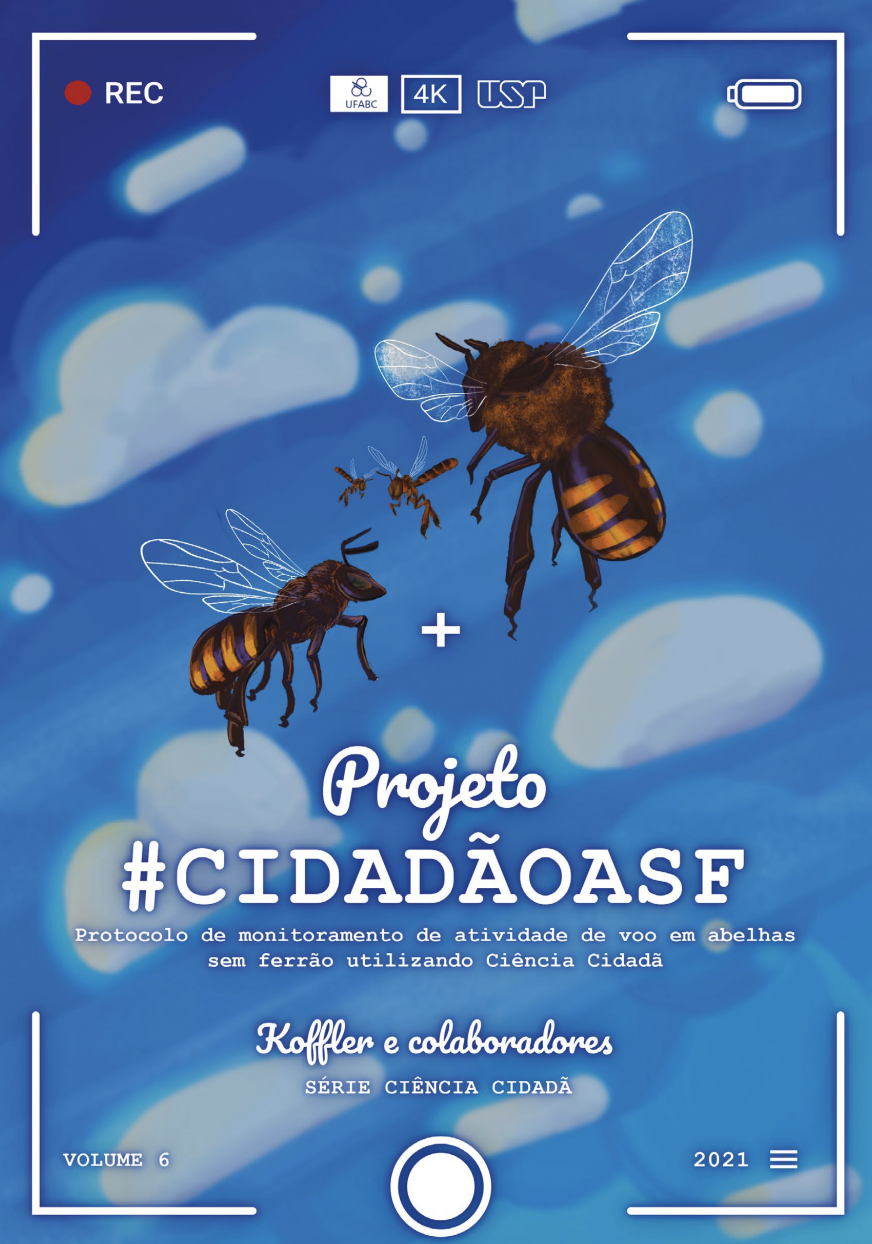 Projeto# cidadãoasf: Protocolo de monitoramento de atividade de voo em abelhas sem ferrão utilizando ciência cidadãS Koffler, NP Ghilardi-Lopes, T Francoy, B Albertini, J Leocadio, C Barbieri, DYM Nakamura, BS Caldeira, L Silva, Y Yamamoto, and AM SaraivaSérie Ciência Cidadã. Santo André: UFABC 2021